
September 15, 2026
Not every job needs a machine the size of a house. Tight backyards, utility trenches, landscaping work, and demolition in confined spaces all call for something smaller, nimbler, and easier to maneuver — without giving up digging power. That’s exactly the gap LEADMAN’s M-Series mini excavators are built to fill.
A Size for Every Job
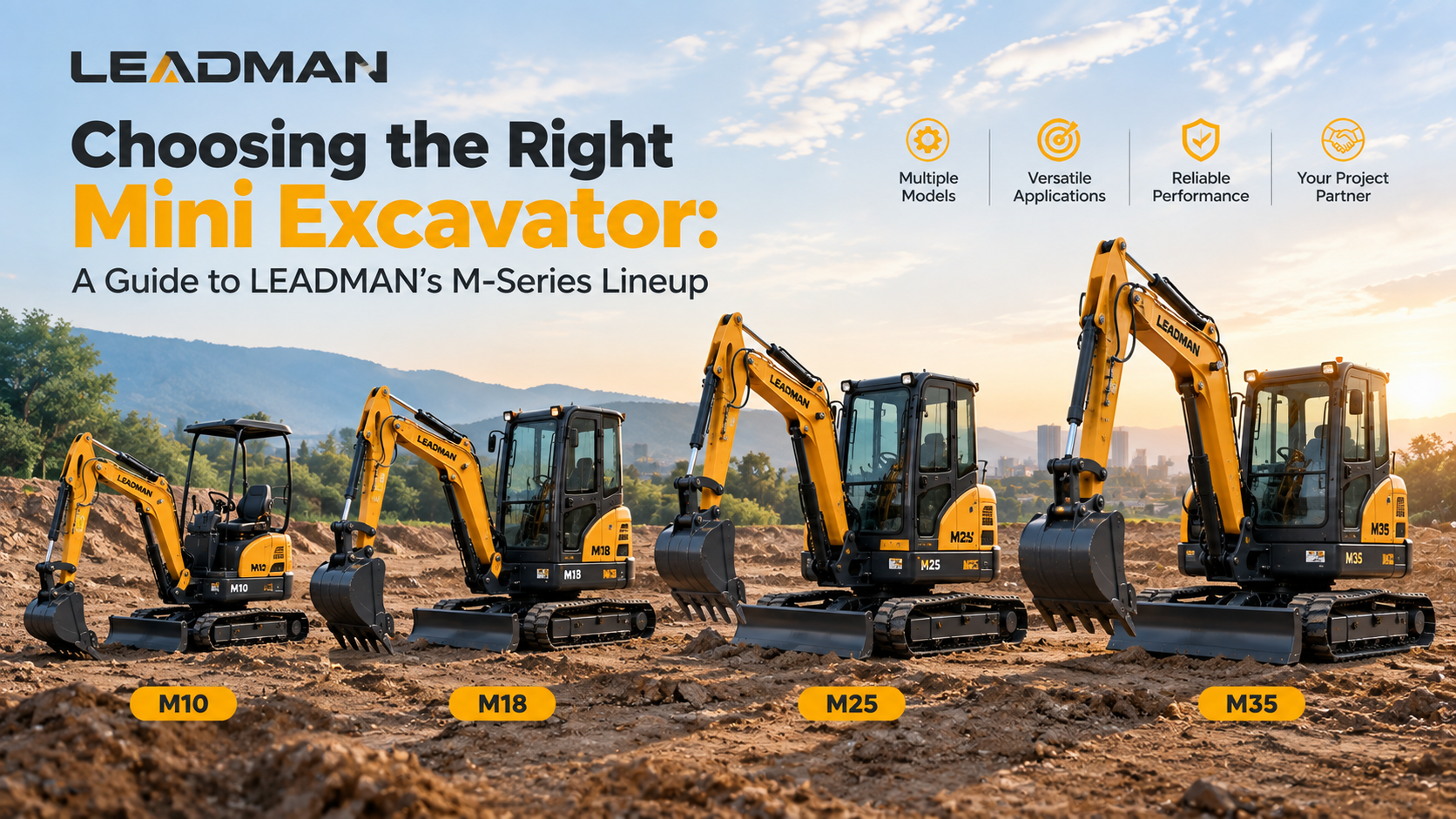
LEADMAN’s mini excavator range runs from the compact M10 all the way up to the M65, giving contractors a machine matched to the scale of the work rather than a one-size-fits-all compromise.
- M10 — The smallest in the lineup at roughly 1,700–2,000 lbs operating weight and about 10 HP, the M10 is built for entry points where full-size equipment simply won’t fit: narrow gates, indoor demolition, and delicate landscaping.
- M12 — Stepping up to 24.4 HP and 6,800–7,100+ lbs, the M12 offers a noticeably larger bucket capacity (0.07–0.21 cbm) for crews that need more digging volume without moving into full mid-size territory.
- M18 / M20 / M25 — This trio sits in the 18 kW (roughly 24–25 HP) class with operating weights climbing from around 2,800 lbs to 4,200 lbs. They’re a natural fit for utility work, small foundation digs, and general site prep where you need consistent power in a still-compact footprint.
- M30 / M26 U / M35 — In the 20 kW (about 27 HP) range with operating weights between 4,800 and 5,300 lbs, these models bring more muscle for grading, trenching, and moving larger volumes of material per pass.
- M35 U — The heavyweight of the compact class, jumping to 7,600–8,000 lbs and a bucket capacity up to 0.21 cbm, bridging the gap toward larger excavation work while retaining mini-excavator maneuverability.
Why Operating Weight and Bucket Capacity Matter
Two specs do most of the work when comparing mini excavators: operating weight and bucket capacity. Operating weight affects stability, trench depth capability, and how the machine handles on soft or uneven ground. Bucket capacity determines how much material you move per cycle — a bigger bucket means fewer cycles, but only if the machine has the weight and horsepower to back it up safely. Matching these two figures to your typical job site, rather than just picking the biggest number, is the difference between an efficient machine and an oversized liability on a tight site.
Matching a Machine to Your Work
- Landscaping and small residential jobs: the M10 or M12 offer enough digging power without tearing up a lawn or requiring wide access.
- Utility and general contracting: the M18–M25 range balances power and compactness for the widest variety of day-to-day tasks.
- Heavier grading and trenching: the M30, M26 U, and M35 provide more weight and bucket volume for larger-scale earthwork.
- Approaching mid-size excavation: the M35 U gives crews the option to scale up without leaving the mini excavator category entirely.
Built to Work Every Day
Across the M-Series, LEADMAN designs each model around the same idea: real digging performance in a package small enough to get where full-size excavators can’t. Whether you’re running a single machine on residential jobs or building out a fleet for a growing contracting business, there’s an M-Series model sized for the work in front of you.
Explore the full mini excavator lineup and specifications at leadmanmachinery.com, or reach out to the LEADMAN team for a quote tailored to your project.